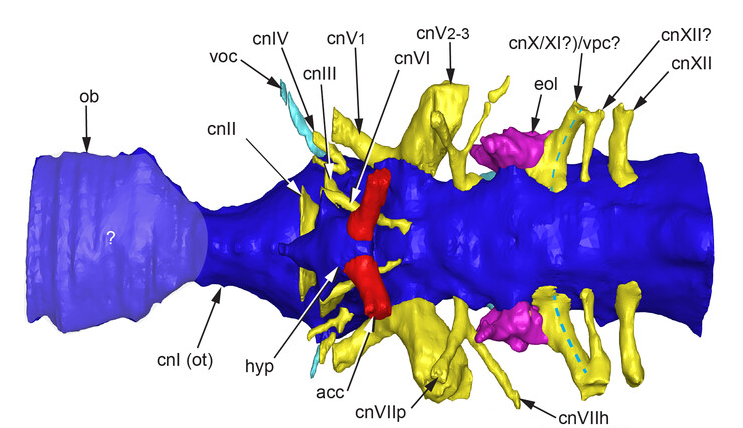
I had a very interesting back-and-forth by email with someone who is trying to figure out reptile hindbrain neuroanatomy, which is not an easy topic. I’ve actually had several conversations about hindbrain neuroanatomy recently with different people coming at it from different angles. It’s been very interesting for me since I’ve never really focussed on the hindbrain/rhombencephalon, but there have been several cool papers in the last ten years or so that have come out and suggested there are interesting things going on back there.
Anyway, this person wanted to know specifically about the two classical divisions of the basal rhombencephalon, the pons/metencephalon and medulla/myelencephalon, and whether they are meaningful divisions in reptiles. My thoughts that I shared with her are below, but tl;dr I don’t think the two divisions are meaningful. However, as I said above this has never been my focus and I would love to hear the opinions of others on the topic, so if you have any please do consider getting in touch.
Question 1:
Hi! My name is [redacted] I'm a predoctoral reseacher in paleontology. I'm working with [redacted]. I have seen contradictory information regarding the presence of the pons in reptiles and birds. Since you work on extant specimens I was wondering if you can recommend me some bibliography. Thank you very much!
My Answer 1:
Hi! Happy to help. The pons is part of the hindbrain. It’s an anatomically-defined structure, meaning it is defined by its shape rather than its developmental origin, homology, function, or the nuclei it contains. It’s a round ventral protuberance that forms the anterior part of the hindbrain in mammals. It does not exist in squamate reptiles, however the specific brain regions that make up the pons exist in squamates. They just do not form the protuberance from the rest of the brain that is called the pons.
I’m also not sure whether the pons exists in birds or crocodiles, which is why I referred to squamate reptiles above. I’d have to check.
A better answer is probably that the pons and the medulla are old-fashioned terms that don’t have a lot of relevance to modern neuroscience. The region that is comparable across vertebrate groups is the rhombencephalon, which, in mammals, is the combination of the pons and the medulla (and, technically, the cerebellum). The rhombencephalon exists in all vertebrates.
Question 2:
Hi,
First, thank you so much for answering me back and helping me out with this topic.
So, very recently two papers (dinosaur paleoneurology) just dropped with contradictory views on whether the pons exists.
As you pointed out, one of them explained that it is a mammalian structure, and so its differentiation from the hindbrain was divided into romboencephalum-cerebellum (anterodorsal) and rhomboencephallum-medulla oblongata (everything else) (I will attached images and papers).
On the contrary, the second paper didn't really explain why they included this terminology (pons).
My questions here are:
1-The "pons" is a non existing region in archosauromorpha, but there is a convergent (non homologous) region or group of them. Is then a proper way to define this area?
2-Since the morphological nomenclature in paleontology is not up to date. Is there a more adequate terminology that we should use for this?
3-In your opinion, are either of these gross divisions of the endocasts okay for a descriptive purpose (not necessarily relating to their embryological origin or functions)?
Again, thank you so much for your time and interest.
My Answer 2:
Hi,
1-The "pons" is a non existing region in archosauromorpha, but there is a convergent (non homologous) region or group of them. Is then a proper way to define this area?
I don't really think about it like that. The pons is a purely anatomical designation, it applies to a round "bump" in the anterioventral rhombencephalon in mammals. There isn't really a way for it to have a convergent region because it has no function, it's just a description of brain morphology. The nuclei that happen to be located in the pons in mammals, like the nerves of the cranial nuclei, nucleus of the lateral lemniscus, and the nucleus of the trapezoid body, all exist in reptiles and birds as well. They just don't form that "bump".
2-Since the morphological nomenclature in paleontology is not up to date. Is there a more adequate terminology that we should use for this?
I would avoid talking about the pons and medulla. Go straight from rhombencephalon to the nuclei.
3-In your opinion, are either of these gross divisions of the endocasts okay for a descriptive purpose (not necessarily relating to their embryological origin or functions)?
Not in reptiles. I don't study mammalian endocasts so I'm not sure if you can see the pons and the medulla in them.
I hope this helps! Please feel free to send me more questions if I can help more!
Dan