Finding Animals in Newfoundland

Newfoundland is a spectacularly beautiful (in a harsh, windswept sort-of a way) island off the northeast coast of North America. I spent late 2021 there at Memorial University in St. John's, and, as is my natural habit, I set out to find as many animals as I could in my spare time. I was there only in the fall, so keep that in mind with respect to my comments on where and how to find things. I'll also include any advice I got from people who seemed to know what they were talking about.

Mammals

Woodland Caribou

There are small numbers scattered all over the island, including on the Avalon Peninsula, but the only place I saw them was along Highway 430, the highway that goes up the Great Northern Peninsula to St. Anthony. I heard that the area around Port-au-Choix is a particular hotspot for them, but I didn't go there. I saw two herds just from the highway, one around Portland Creek and the other near Green Island Cove.

Red Fox

There's a habituated family on the road to Cape Spear, right where the asphalt road turns into gravel. They approach cars like they're used to being fed, so drive carefully!

Canadian Beaver

Newfoundland is pock-marked with ponds and lakes, and you drive by them constantly on the highways. Many, many of these ponds have active-looking beaver dams and staking one out for a while would probably yield successful beaver sightings. I didn't do this, and I didn't see any beavers just with quick glances at the lakes as I wizzed by at 100km/hr. The only beaver I saw was in a pond on the hike to Gros Morne Mountain.

Ermine

The only small weasel present on the island, they're found all over the island but aren't easy to see. The only place I saw one was at the picnic area by the pond at the Memorial University Botanical Gardens. It was foraging around like it was used to being fed.

River Otter

Once again, the only one I saw acted like it was used to being fed. It was in the farm pond on the Skerwink Train and swam over to us as we approached the pond. We stood there watching it, as it swam back and forth, periscoping and watching us.

Meadow Vole

There seem to be lots of these on the Great Northern Peninsula but I didn’t see an evidence of them anywhere else. On the Great Northern Peninsula, I saw them at both Cape Norman and Flower's Cove.

Mystery Vole

I saw a vole with a distinctly yellowish head running between boulders at the base of Gros Morne, where the climb up the gully starts. If I were on the mainland, I would have confidently said it was a rock vole, but apparently those don't occur on the island. And because the place I saw it is so accessible, and is part of a national park, I suspect it has been thoroughly sampled. If a population of rock voles lived there, it would be known. So I've just chalked this one up as unidentifiable.

Atlantic White-sided Dolphin

These seem to be relatively common. We went on a boat tour from the Bonavista Peninsula at the end of October and we found a super-pod of hundreds of them. The water all around the boat was boiling with them, it was an amazing sight. Apparently these super-pods are a fall occurrence, they are seen in smaller groups in the summer and can be hard to find in the spring.

I also saw a small pod of them looking out from my cabin near Carbonear, one of the Mad Rock Cabins. And I found a dead one washed up near St. Anthony.

White-beaked Dolphin

The Sea of Whales tour operator, who took us to see the white-sided dolphins, told us that spring is the time to see these around Bonavista, and he doesn't see them in the summer or fall.

I saw them only from the Cape Norman lighthouse on the Great Northern Peninsula, a well-known whale-watching spot. Their dorsal fins are so big that at a distance I had trouble telling them from (female) orcas!

Minke Whale

I saw these surface-feeding from the Cape Norman lighthouse, in association with the white-beaked dolphins. It was very neat to watch their huge mouths come out of the water and go along the surface.

Harbour Seals

Apparently they very common, but I noticed a distinct lack of seals the entire time I was in Newfoundland. People there absolutely hate seals; they get a lot of blame for keeping the cod stocks from recovering, and I suspect seals are harassed in a lot of places. This was particularly apparent when I took the ferry to St Pierre and immediately spotted seals hauled out around the harbour there.

On Newfoundland itself, just about the only place I found seals is around the southern end of the Avalon Peninsula, in particular in the harbours along the Irish Loop.

Hooded Seals

These were the only seals I found that were not habour seals. I saw a few of these hauled out with some harbour seals at the Mistaken Point Ecological Reserve, at the first point where the trail to Watern Cove looks out over the shoreline. I’m not sure if they’re regular there, I was there after a big storm and they might have just been resting up. Also, this is a famous location for Ediacaran fossils, unfortunately the places they are visible are only accessible on guided tour.

Birds

There are too many birds to list and discuss. My full list for Newfoundland can be found on my eBird profile here. It's lacking the most famous bird for the area - Atlantic puffin - as they move offshore outside the breeding season.

Newfoundland gets lots of vagrants. There were several warblers, some rare even for Canada, hanging around into December. I didn't chase them down, but if you're into that sort of thing it'd be worth checking out eBird, the Newfoundland Birders Google Group, and Jared Clarke's Twitter to see what's around.

Bald Eagle

Common soaring around the coast and over the highways, even a long way inland (probably because of all the ponds and lakes), but definitely not as easy to find as on the coast of British Columbia or Alaska. The whale watching tour out of Bonavista (Sea of Whales) took us to an active nest.

Rock Ptarmigan

Just about the only place you can find them is on the peaks of the Long Range Mountains in western Newfoundland, and just about the only accessible peak is Gros Morne. I was pleasantly surprised to see lots of them - upwards of 20 - while walking across the plateau. Not sure if that's normal or if its been a particularly good year for them.

Boreal Chickadee

I rarely see these elsewhere in Canada, so it was a pleasure to discover that they are probably the most common forest bird on the Avalon Peninsula, where the black-capped chickadee is rare. Further west on the island the black-capped gets progressively more common and the boreal harder to see.

White-winged Crossbill

Common across the island wherever there are conifers. A rare treat for me elsewhere in Canada, it was great to see them so frequently.

Northern Fulmar

Hard to see. I saw them once from shore after a big storm, and once from the ferry to St Pierre.

Dovekie

Easy to see from shore in the late fall and winter. Very hard otherwise.

Reptiles

What reptiles? I didn't see a single reptile my entire time there, because there are almost none in Newfoundland. However, according to Sea of Whales, leatherback turtles seem to be getting more regular, to the point where it might just be possible to target them on a trip.

Amphibians

There aren't any amphibians native to Newfoundland, and the introduced ones are suprisingly hard to come across, despite the abundance of fresh water. I only saw green frogs and American toads once - driving along Route 73 at night during a rainstorm.

Other

Strombolites at Flower’s Cove

Strombolites!

There are only a small handful of places in the world where strombolites exist. I had no idea that western Newfoundland was one of those places until I drove past a small, unassuming sign for a "strombolite walk" at Flower's Cove. These have to be the least promoted strombolites in the world. If you have the time, check them out! They are rare, weird, and totally underappreciated.

Some comments on stuff I didn't see

Orca - Sea of Whales tour operator out of Bonavista targets these in the fall, after the migratory whales have gone. But he still only sees them about once in every four trips. Gotta get lucky!

Seals - I was hoping to see bearded, harp, and ringed seals during my time on Newfoundland, but given how hard harbour seals were to find, I didn't maintain much hope. Apparently harp seals regularly haul up at some harbours (I was told Holyrood is a good spot) during the dead of winter. They are also regular in early spring on the ice that flows down from Labrador along the north shore. Bearded seals are uncommon and erratic but turn up regularly, apparently. Ringed seals are either very rare or are overlooked because they look so much like harbour seals.

Muskrat - Apparently there's been a steep decline in their population recently, and it's currently unknown why. They used to be very common but are now almost impossible to see.

Arctic Hare - Present only on the most barren tundra-like spots. I looked for them on top of Gros Mourne and at Burnt Cape Ecological Reserve but wasn't lucky enough to see one.

Willow Ptarmigan - Present all over the island but hard to see. Their population follows boom-and-bust cycles and I think I was there at a low ebb. I looked in several known spots and couldn't come up with one.

Leatherback Turtle - I was surprised to see pictures of these featured prominently on the websites of whale watching companies. It seems they are becoming a regular thing, which is very neat. The Sea of Whales boat tour out of Bonavista said he sees them mostly August-October and will see about one a week during that time. Not great odds, but a lot better than I was expecting! A biologist I talked to in Terra Nova National Parks also said he thinks they're becoming more regular in Newfoundland waters and suspects global warming may be responsible.

Two papers, one brain (image)

Way back in 2011, I collected 13 adult male dragon lizards. At the time they were considered tawny dragons (Ctenophorus decresii). Since then, the tawny dragon has been the subject of intense study, including genetic study of its populations. As a result, we know now that the tawny dragon isn’t a species after all, but three species. Today, what I collected is known as the swift dragon (Ctenophorus modestus), and unfortunately the two papers I published describing the brain anatomy of those thirteen lizards both refer to them as the wrong species.

A swift dragon (Ctenophorus modesta), photographed by Tobias Hayashi during fieldwork to collect dragons for my PhD in 2011. At the time, this was considered a tawny dragon (Ctenophorus decresii).

Two papers. The same 13 individuals. How, and why, would someone go through all the trouble of publishing two papers on the same thing? Other than the obvious publish-or-perish, academia-as-an-infinite-hamster-wheel-of-papers reason? Please let me to explain.

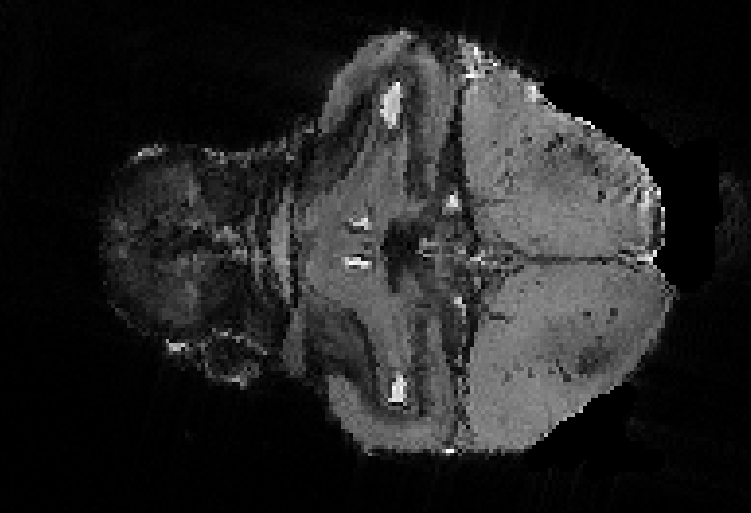
Early in my PhD I was trying to figure out how to study lizard brains. Luckily, I happened to meet Jeremy Ullmann, who had done his PhD on fish brains and was doing a postdoc segmenting a mouse brain MRI model (more on that in a second). Amongst many other crucial contributions he made to my PhD, Jeremy introduced me to the idea of using MRI to study lizard brains, as he had done with fish and mice. The primary advantage was that you can study the anatomy of the entire brain at once instead of being limited to specific structures of interest, as is the case for more traditional neuroanatomical methods.

A slice through an MRI, fresh out of the scanner, with no post-processing. This is a lateral view of a lizard head facing right. The brain is clearly visible, can you see it?

Here’s the head of a swift dragon - possibly even the same individual - in the same orientation as the MRI above.

A model, in the sense I’m using here, is outwardly similar to an MRI in that it’s a 3D, greyscale image. However, instead of being an image generated by measuring the effect of changing magnetic fields on the spin of hydrogen atoms, a model is a meta-that. It’s an “average” of many MRI images that are all more-or-less of the same thing, in this case brains all from the same species, and sex, of lizard. Because the model is an amalgamation of multiple images, it is able to drastically increase the signal, and reduce the noise, in the original images. This results in a much clearer picture of the brain. The model Andrew built is now the basis for two papers describing lizard brain anatomy. This is Jeremy’s fault.

Jeremy, as I said, was working on segmenting a mouse brain model at the time. Let’s talk about segmentation. An MRI image - or model - is made up of voxels. Voxels are 3D pixels, and segmentation is the process of assigning each voxel an identity. In Jeremy’s case (and in my case), the identity is the anatomical region that voxel is part of (cortex, thalamus, basal ganglia, etc). Jeremy’s full time job, what he had been working on for years, was segmenting certain parts of the mouse brain. Not even the whole thing, just bits of it. A brain image or model segmented into its anatomical regions is called a segmentation atlas. Pictures of brains with the anatomical regions labelled in any fashion is called a brain atlas.

My aspiration, which I explained to Jeremy, was to segment the whole lizard brain model. When I started my PhD, there hadn’t been a reptile brain atlas published since the early 1990s. The ones that were available, though very useful, were woefully inadequate compared to the modern atlases published for other vertebrate groups. This only added to the difficultly of what I was proposing and Jeremy, wisely, advised against this plan. A full segmentation atlas was an insurmountable amount of work for a PhD student. At best, I would graduate with a thesis that was entirely just the atlas, if I were able to finish it on time.

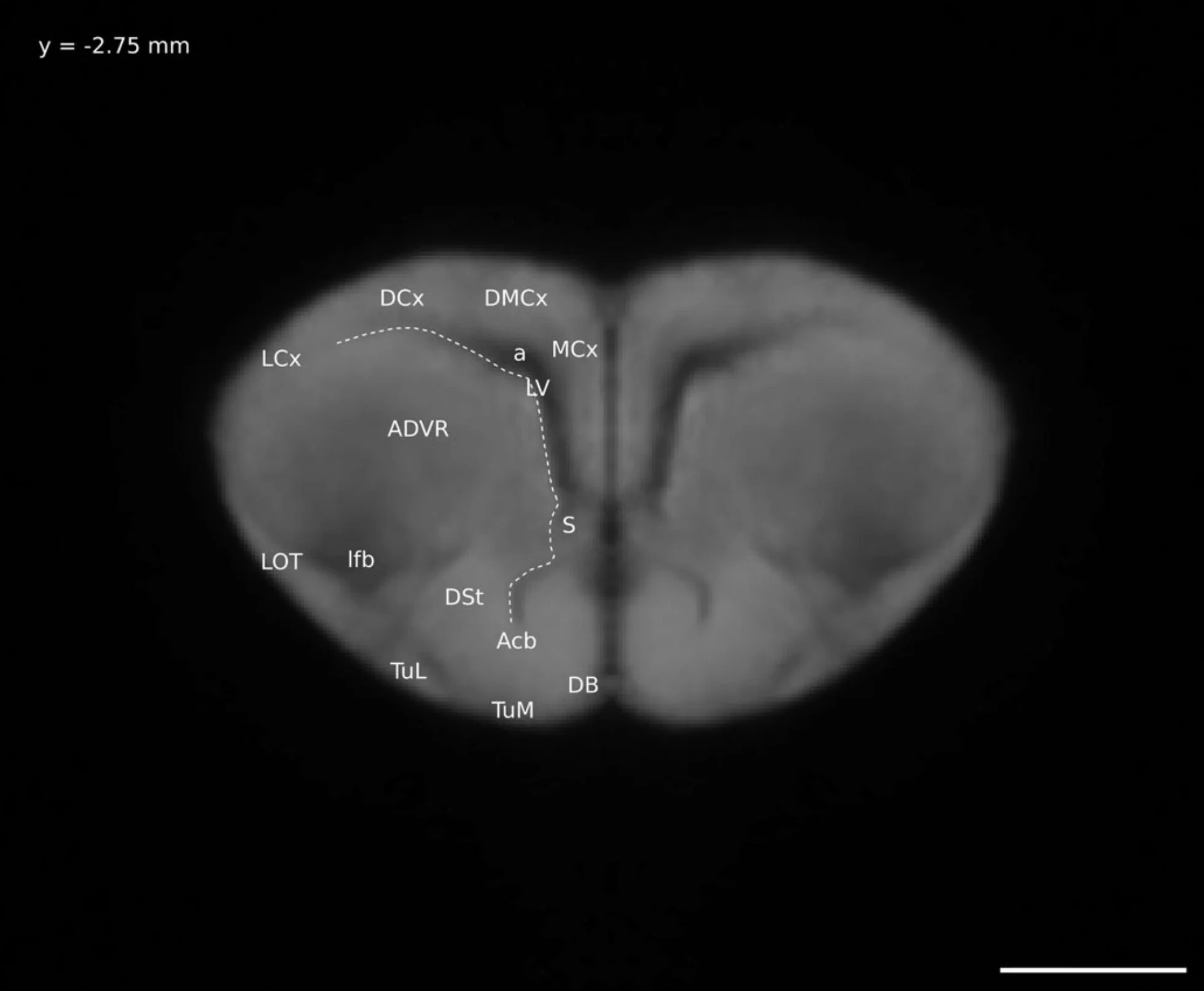
So instead I did half the work: I figured out what brain regions were visible on my Ctenophorus decresii/modesta brain model and, instead of the long process of digitally “painting” the brain regions onto the model, I took select images of the model and labelled them. This is the format of a normal brain atlas, including the ones most in use today. The brain is sliced (digitally in my case) and pictures are taken of each slice. The brain regions visible in each picture are labelled. A version of this atlas was included in my thesis (as one of five chapters, not the whole thing) and the final version was published here.

A digital “slice” through my lizard brain model, with the distinguishable anatomical regions labelled. This is Figure 6 in this paper.

This atlas is enough for most people, as Jeremy astutely advised me it would be. Most people who would need to know brain anatomy don’t work with brains in 3D, they work in 2D. The vast majority of neuroscience is done with brain slices, often looking down a microscope at them, or, an improbably high amount of the time, just holding the brain slice really close to one’s face and squinting at it. To identify brain regions on these slices, what you need is not a 3D image that has been segmented into brain regions, but a series of 2D images you can flip through until you find the image that most closely resembles the slice of the brain you are interested in. So most of the time, someone interested in lizard brain anatomy will find my 2018 brain atlas most useful.

A histological section through a lizard brain (left) and the corresponding figure from my brain atlas (right). This is figure 41 from this paper.

The segmentation atlas came into being out of necessity; my own personal necessity. The information in the segmentation atlas is essentially identical to that in my traditional brain atlas because the 2018 atlas was used as the primary source for anatomical information for the segmentation atlas. What’s different, then, is who - or what - the information is geared to. The traditional-style atlas is designed to be easily understood by humans. The segmentation atlas is designed to be easily understood by computers.

The purpose of the segmentation atlas is to measure 3D lizard brain images. I myself have over 400 lizard brain MRIs, some collected during my PhD and others during my time as a postdoc at SickKids Hospital in Toronto. I have exactly zero desire to measure these brain images by hand, and it would be physically impossible for me to measure all the brain regions in the segmentation atlas by hand. That is the purpose of the segmentation atlas, the reason for its existence. It can measure all the brain regions, over the entire lizard brain, in all of my MRI images, and it can do it with better precision than a human.*

It can also do this for your 3D lizard brain images, if you have any. Be they MRI, CT, confocal, lightsheet, endocast, etc, you’re far better off using the segmentation atlas to get whatever measurements you want out of your images than you are trying to do them by hand. Save yourself time, frustration, heartache, and repetitive strain injuries. Let the computer take the measurements for you, the segmentation atlas is published here.

So that’s why I published two different papers using the same lizard brain model. To make it easier for people who want to study lizard brains, including myself, whether they use traditional 2D histological techniques, or more newfangled 3D imaging. These two atlases will hopefully make lizard brain research much less daunting than it was when I started by collecting those tawny dragons - or swift dragons, or whatever - ten years ago.


* Not better accuracy, though. I’m still responsible for quality control.


Anyone up for a camera trap mystery?

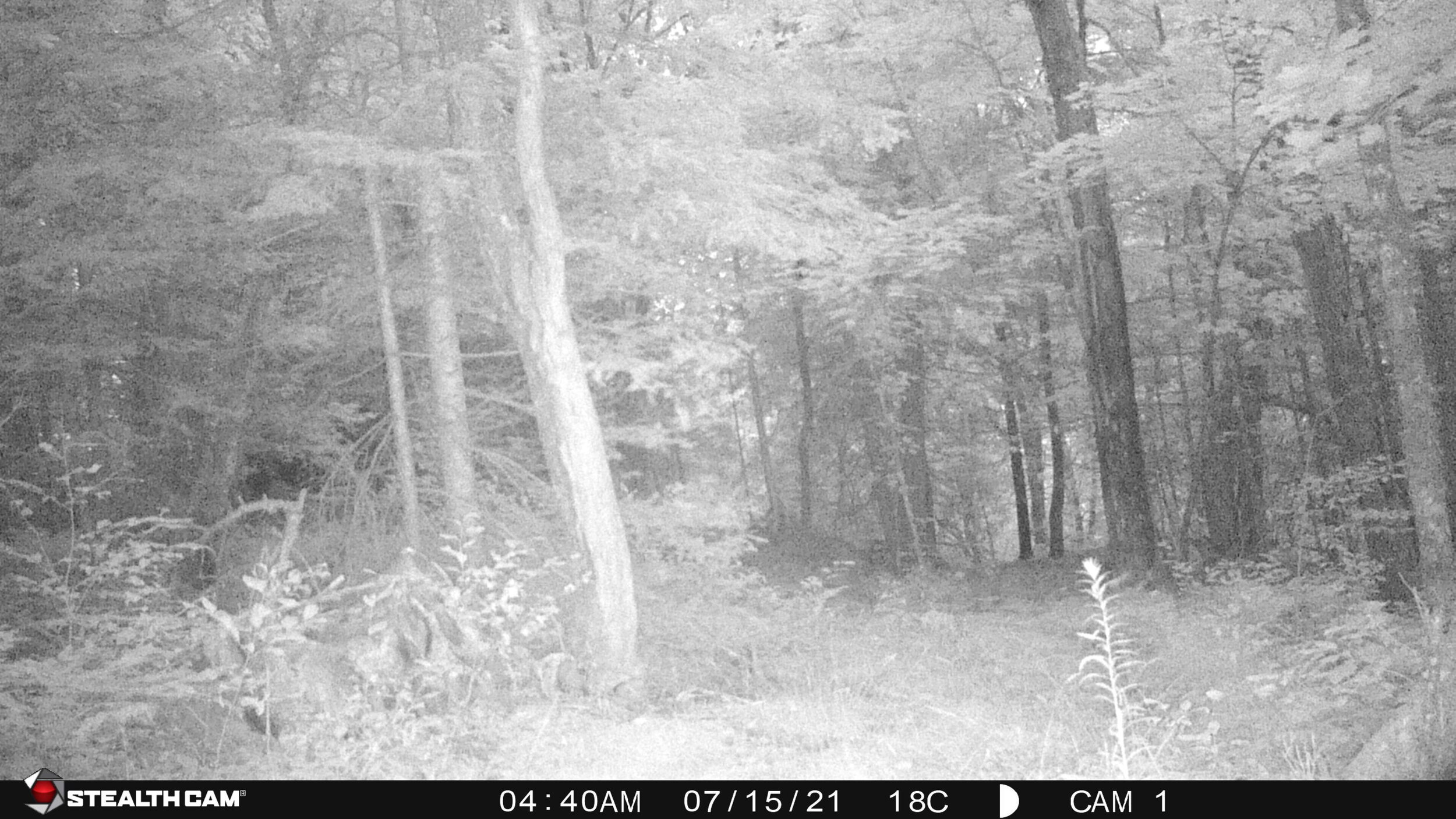
A camera trap at my parent’s property near Burks Falls, Ontario captured this series of images:

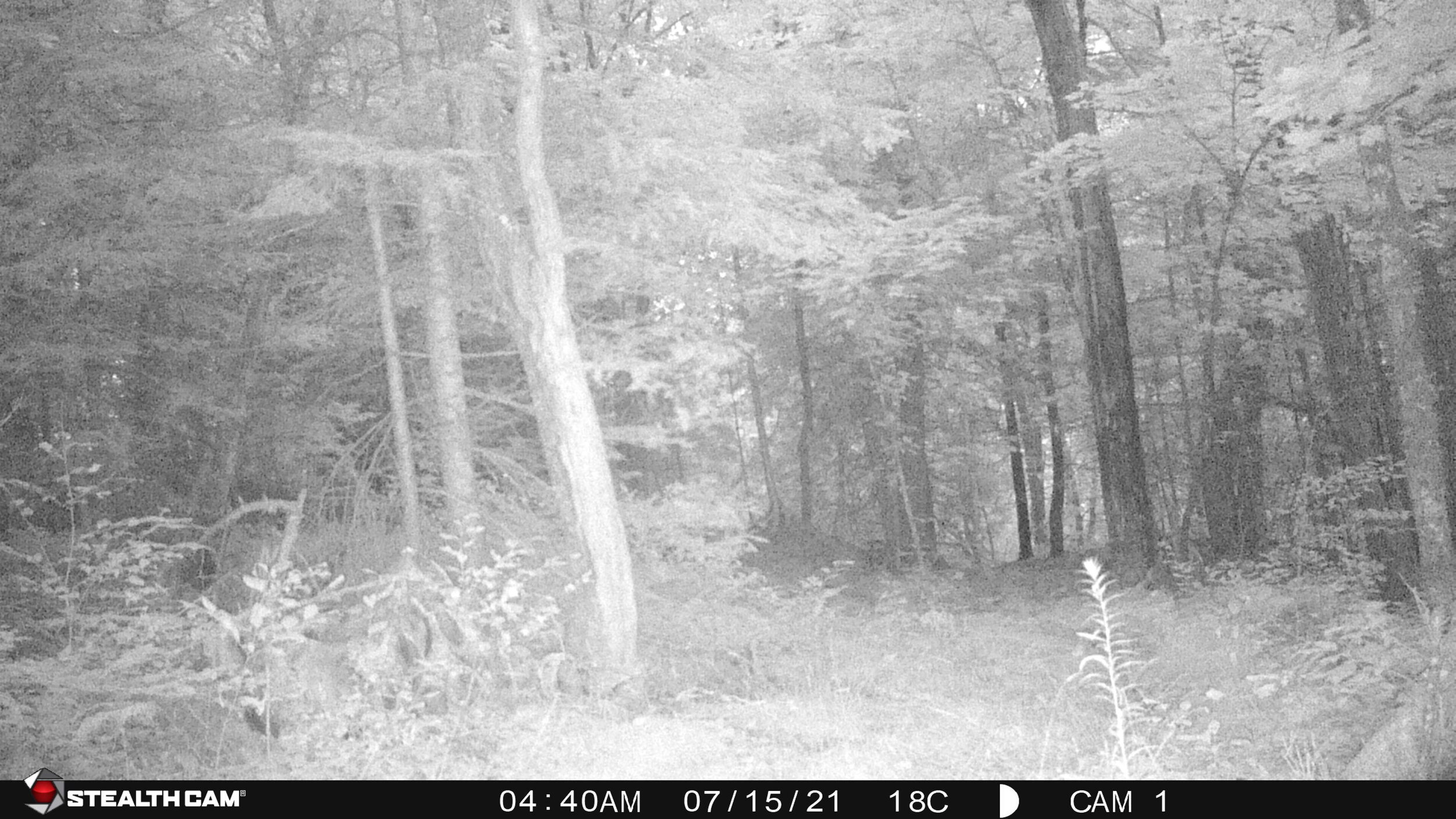
The first three images show a large, dark animal moving through the trees, the fourth is a picture with no animals for comparison. Here they are as a gif:

After staring at this gif for way too long, I’m pretty sure I know what animal this is. Anyone else want to hazard a guess?

Update Oct. 2021: It’s a moose.

Backyard Birdwatching

One of my passions in life is animal-watching, and most of my travels involve some amount of searching for birds, mammals, or herps (reptiles & amphibians). I was very much looking forward to this spring, my first in Toronto since graduating high school, so that I could try to find some of the amazing birds that pass through this area during migration. Unfortunately, I’ve had to put most of those plans on hold due to the viral pandemic that’s got the entire world shut down for the moment.

My work-from-home set-up, perfect for being distracted from work by birds. The pictures below are taken through these windows.

Given our collective circumstances, I’m fortunate to be isolated with an excellent work-from-home set-up where I face a wall of windows behind my computer screens, perfect for working and birdwatching simultaneously. I’m also lucky to be living at a place with a large backyard that has a lot of vegetation, including some huge old oak trees. So now, with the great wave of migratory birds about to arrive, I thought I’d start my list of birds that I’ve seen while birding from home. I’m going to keep adding to it as long as the pandemic keeps us locked up. We’ve all got to keep busy somehow!

Update #2: It’s now May 2021 and not only is the pandemic ongoing, but here in Ontario we’re back in a lockdown just like this time last year. So I guess I should update this list. This year wasn’t nearly as good for backyard birding as last year, but so far I’ve seen three species this year that I didn’t see in my yard last year:

62-Willow Flycatcher

61-Baltimore Oriole

60-Canada Goose
Honestly it’s inexplicable that I didn’t see any last year from my hard. This year several migrating flocks flew over the yard.

Update: It’s the end of June and Toronto is into Phase 2 of its reopening. I’m back at the office for 12 strictly-controlled hours a week, which means quarantine is over, I guess? Anyway, it’s time to end this list. One last bird to add that I saw today and then I’m done at the very unsatisfying 59 bird species in my yard during quarantine. Oh why couldn’t I have seen some Canada geese flyover???

59-Cedar Waxwing
I’ve been hearing them for a while, but I finally managed to see three of them feeding.

58-Great Crested Flycatcher
It’s June now and things have settled down, but the occasional new bird still pops up!

57-Mourning Dove
Flyover

56-Cliff Swallow
Flyover

55-Northern Grackle
Flyover, and not one I was expecting to take so long to show up!

54-Red-eyed Vireo

53-Canada Warbler

52-Common Nighthawk
Flyover

51-Cape May Warbler

50-Red-headed Woodpecker
What a spectacular and rare bird for my fiftieth species!

49-Red-tailed Hawk

48-Tennessee Warbler

47-Swainson’s Thrush

46-Chimney Swift

45-Least Flycatcher

44-Magnolia Warbler

43-Black-throated Blue Warbler

42-American Redstart
The last seven species were all first observed on the same day!

41-American Goldfinch

40-Lincoln’s Sparrow

39-Veery

38-Chipping Sparrow

37-Rose-breasted Grosbeak

36-Ovenbird

35-Brown Thrasher

34-Blue-headed Vireo

33-Brown-headed Cowbird

32-Blackburnian Warbler

31-Blue-grey Gnatcatcher

30-Palm Warbler

29-Black-throated Green Warbler

28-Philedelphia Vireo

27-Black-and-white Warbler
May’s started and the birding is ramping up!

26-Red-winged Blackbird
Flyover

25-Nashville Warbler

24-Yellow-rumped Warbler
First warbler! Seen the last days of April

23-White-throated Sparrow
A flock of at least 30 descended on my backyard one afternoon, seemingly out of nowhere. Spectacular!

22-Mallard Duck
Flyover

21-Ring-billed Gull
Flyover

20-Brown Creeper
This was the last of the widespread Ontario birds for me to finally tick off my lifelist, so it was a real pleasure to look up from my computer and notice one creeping up a tree about 3m from where I was sitting.

19-Northern Flicker

18-Ruby-crowned Kinglet

17-Golden-crowned Kinglet
My garden seemed to be filled with these for a couple days mid-April; they were even hopping around quite close to the ground. Very beautiful little birds.

16-Eastern Phoebe

15-Double-crested Cormorant
A strange backyard birding tick since there’s no water in my yard, they were a fly-over.

14-Hermit Thrush

13-Blue Jay

12-American Crow
Surprisingly rare in my yard, considering how common they are in Toronto in general. I’ve only seen them once this spring, mobbing a Cooper’s hawk.

11-Cooper’s Hawk

10-Turkey Vulture
Flyover

9-White-breasted Nuthatch

8-Red-breasted Nuthatch
Seen for the first time ever in my yard early this spring, when there was still plenty of snow on the ground. Not seen since.

7-Yellow-bellied Sapsucker

6-Hairy Woodpecker

5-Downy Woodpecker

4-Dark-eyed Junco

3-Northern Cardinal

2-Black-capped Chickadee

1-American Robin


I also have a list of mammals seen from my backyard since the start of the pandemic, but it’s pretty pathetic:

4-Eastern Chipmunk

3-Raccoon

2-American Grey Squirrel

1-Eastern Striped Skunk

An excellent account of the wild mammals of Toronto is here. I’m hoping a few more of these are around my yard, like Virginia Opossum and White-footed Mouse.